Recommended as first-line treatment per the RRP Foundation consensus statement.1,2
Intended for US healthcare professionals only.
The standard of care for RRP is clear1,2
The first and only FDA-approved therapy to treat recurrent respiratory papillomatosis (RRP) in adults.1,3
Recommended as first-line treatment, PAPZIMEOS is a non-replicating adenoviral vector-based immunotherapy designed to generate an immune response directed against HPV 6- and HPV 11‑infected cells in adults with RRP.1,2
HPV=human papillomavirus.
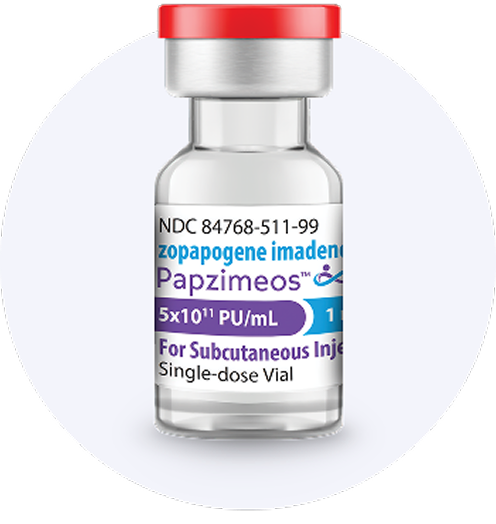
Not actual size.
About PAPZIMEOS
Get the full PAPZIMEOS story, including the mechanism of action, clinical trial design, efficacy results, safety data, and dosing information.
Discover the PAPZIMEOS storySupport for your patients and practice
Papzimeos SUPPORT can help support your patients and care team at any site of care throughout the access process. For questions or support, call (866) 827-8180, Monday to Friday, 8 AM to 8 PM ET.
Learn how it works
PAPZIMEOS resources
Downloadable resources to help both your patients and your practice.
Get started
Thank you for registering for updates from Precigen.
A representative will reach out to you soon.
We look forward to communicating with you.
INDICATION
PAPZIMEOS is a non-replicating adenoviral vector-based immunotherapy indicated for the treatment of recurrent respiratory papillomatosis in adults.
Important Safety Information
CONTRAINDICATIONS
None.
WARNINGS AND PRECAUTIONS
Injection-Site Reactions: Injection-site reactions have occurred with PAPZIMEOS injection. Monitor patients for local site reactions for at least 30 minutes after the initial treatment.
Thrombotic Events: Thrombotic events may occur following administration of adenoviral vector-based therapies. Monitor patients for signs and symptoms of thrombotic events and treat events according to clinical practice.
ADVERSE REACTIONS
The most commonly reported adverse reactions (≥5% of patients) in PAPZIMEOS-treated patients were injection site reactions, fatigue, chills, pyrexia, myalgia, nausea, headache, tachycardia, diarrhea, vomiting, and hyperhidrosis.
USE IN SPECIFIC POPULATIONS
Pregnancy: There are no available data with PAPZIMEOS in pregnant women.
Lactation: There is no information available on the presence of PAPZIMEOS in human milk, the effects on the breastfed infant, or the effects on milk production. The developmental and health benefits of breastfeeding should be considered along with the mother’s clinical need for PAPZIMEOS and any potential adverse effects on the breastfed child from PAPZIMEOS or from the underlying maternal condition.
Pediatric Use: The safety and effectiveness of PAPZIMEOS have not been established in pediatric patients.
Geriatric Use: Clinical studies of PAPZIMEOS did not include sufficient numbers of patients 65 years of age and older to determine whether they respond differently from younger patients.
To report SUSPECTED ADVERSE REACTIONS, contact Precigen, Inc. at 1‑855‑PGE‑NRRP (1‑855‑743‑6777) 1‑855‑PGE‑NRRP (1‑855‑743‑6777) or medinfo@precigen.com or FDA at 1‑800‑FDA‑1088 or www.fda.gov/medwatch.
Please see full Prescribing Information.
INDICATION
PAPZIMEOS is a non-replicating adenoviral vector-based immunotherapy indicated for the treatment of recurrent respiratory papillomatosis in adults.
Important Safety Information
CONTRAINDICATIONS
None.
WARNINGS AND PRECAUTIONS
Injection-Site Reactions: Injection-site reactions have occurred with PAPZIMEOS injection. Monitor patients for local site reactions for at least 30 minutes after the initial treatment.
Thrombotic Events: Thrombotic events may occur following administration of adenoviral vector-based therapies. Monitor patients for signs and symptoms of thrombotic events and treat events according to clinical practice.
ADVERSE REACTIONS
The most commonly reported adverse reactions (≥5% of patients) in PAPZIMEOS-treated patients were injection site reactions, fatigue, chills, pyrexia, myalgia, nausea, headache, tachycardia, diarrhea, vomiting, and hyperhidrosis.
USE IN SPECIFIC POPULATIONS
Pregnancy: There are no available data with PAPZIMEOS in pregnant women.
Lactation: There is no information available on the presence of PAPZIMEOS in human milk, the effects on the breastfed infant, or the effects on milk production. The developmental and health benefits of breastfeeding should be considered along with the mother’s clinical need for PAPZIMEOS and any potential adverse effects on the breastfed child from PAPZIMEOS or from the underlying maternal condition.
Pediatric Use: The safety and effectiveness of PAPZIMEOS have not been established in pediatric patients.
Geriatric Use: Clinical studies of PAPZIMEOS did not include sufficient numbers of patients 65 years of age and older to determine whether they respond differently from younger patients.
To report SUSPECTED ADVERSE REACTIONS, contact Precigen, Inc. at 1‑855‑PGE‑NRRP (1‑855‑743‑6777) 1‑855‑PGE‑NRRP (1‑855‑743‑6777) or medinfo@precigen.com or FDA at 1‑800‑FDA‑1088 or www.fda.gov/medwatch.
Please see full Prescribing Information.
INDICATION
PAPZIMEOS is a non-replicating adenoviral vector-based immunotherapy indicated for the treatment of recurrent respiratory papillomatosis in adults.
Important Safety Information
CONTRAINDICATIONS
None.
WARNINGS AND PRECAUTIONS
Injection-Site Reactions: Injection-site reactions have occurred with PAPZIMEOS injection. Monitor patients for local site reactions for at least 30 minutes after the initial treatment.
Thrombotic Events: Thrombotic events may occur following administration of adenoviral vector-based therapies. Monitor patients for signs and symptoms of thrombotic events and treat events according to clinical practice.
ADVERSE REACTIONS
The most commonly reported adverse reactions (≥5% of patients) in PAPZIMEOS-treated patients were injection site reactions, fatigue, chills, pyrexia, myalgia, nausea, headache, tachycardia, diarrhea, vomiting, and hyperhidrosis.
USE IN SPECIFIC POPULATIONS
Pregnancy: There are no available data with PAPZIMEOS in pregnant women.
Lactation: There is no information available on the presence of PAPZIMEOS in human milk, the effects on the breastfed infant, or the effects on milk production. The developmental and health benefits of breastfeeding should be considered along with the mother’s clinical need for PAPZIMEOS and any potential adverse effects on the breastfed child from PAPZIMEOS or from the underlying maternal condition.
Pediatric Use: The safety and effectiveness of PAPZIMEOS have not been established in pediatric patients.
Geriatric Use: Clinical studies of PAPZIMEOS did not include sufficient numbers of patients 65 years of age and older to determine whether they respond differently from younger patients.
To report SUSPECTED ADVERSE REACTIONS, contact Precigen, Inc. at 1‑855‑PGE‑NRRP (1‑855‑743‑6777) 1‑855‑PGE‑NRRP (1‑855‑743‑6777) or medinfo@precigen.com or FDA at 1‑800‑FDA‑1088 or www.fda.gov/medwatch.
Please see full Prescribing Information.
References: 1. PAPZIMEOS. Package insert. Precigen, Inc; 2025. 2. Best SR, Friedman AD, Rosen CA, et al. Recurrent Respiratory Papillomatosis Foundation position statement on the management of adults with RRP. Laryngoscope. Published online January 16, 2026. doi:10.1002/lary.70379 3. Norberg SM, Valdez J, Napier S, et al. PRGN‑2012 gene therapy in adults with recurrent respiratory papillomatosis: a pivotal phase 1/2 clinical trial. Lancet Respir Med. 2025;13(4):318‑326. doi:10.1016/S2213‑2600(24)00368‑0